
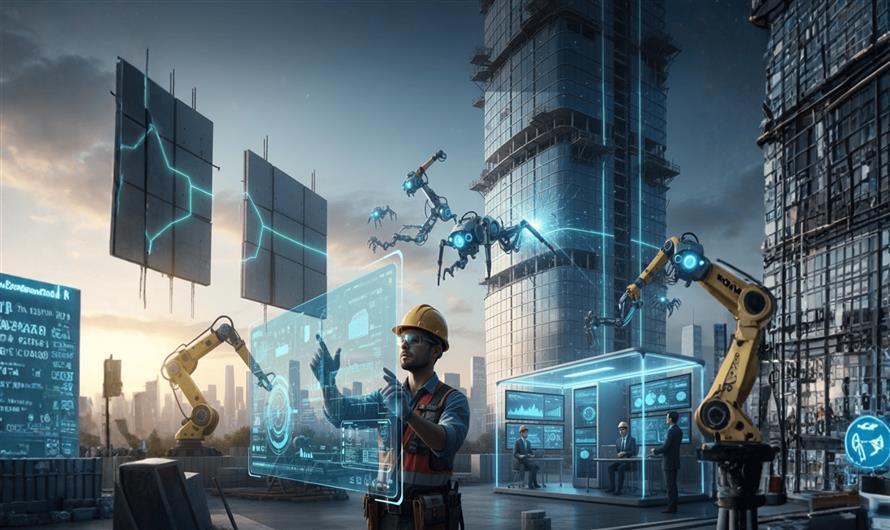
The construction sector is a new age where Artificial Intelligence (AI) is contributing to the development of how the projects are designed, managed and constructed. Construction is a sector that is no longer perceived as slow to follow AI and uses it to enhance efficiency, safety, and innovations.
Smarter Planning and Design
Big data can be analyzed using AI tools to assist in designing, which should enable the architects and engineers to make more informed decisions at the design stage. These systems are able to produce 3D models, anticipate possible design problems and propose solutions to these problems before construction commences. This is time-saving, less rework and better quality of the project.
Project Management Effectiveness.
The systems that are powered by AI assist project managers to keep on track of schedule and budget. They are able to monitor the progress in real time and analyze the performance data and spot the delays or risks early. Through these understandings, teams can be able to make rapid adjustments and continue running the project in a smooth manner.
Enhanced Safety on Sites
Construction sites are dangerous, and AI is transforming this scenario. Artificial intelligence (AI) based smart cameras and sensors may identify dangerous behavior and monitor workers, and notify them about violations of safety rules. The tools can be used to avoid accidents and provide a safer working environment.
Equipment Predictive Maintenance.
Through the analysis of use and performance data, AI can identify the time when the machinery may break down. It enables the companies to plan on how to maintain their apparatus prior to a failure. The outcome is the reduction of downtime, less expensive maintenance, and operations.
Environmentally Friendly Building.
AI contributes to the sustainability of construction. It may propose materials that minimize wastes, enhance energy saving, and environmental reduction. The AI can also be used to monitor the consumption of power on the premises and identify-ways of minimizing the carbon emission in the construction process.
Better Quality Control
Ai systems are able to identify defects in materials or construction work by comparing images and data with pre-determined quality benchmarks. This makes sure that mistakes are detected early enough and rectified before they end up being more serious.
Improved Cost Estimation
AI is able to analyze past projects and market data quickly given that it can give an accurate cost estimate. This would assist companies to budget much better and the possibility of having financial surprises in future is minimized.
Robotics and Automation
AI-controlled robots are beginning to perform repetitive and hazardous work, including bricklaying, welding, or concrete pouring. This does not only make it more productive, but also minimizes the possibility of human injury.
Future of AI in Construction
AI will continue to evolve and bring even more innovation to construction. In the future, we may see fully automated project management systems, self-learning machines that adapt to new building challenges, and smart cities built with AI-driven planning.
AI is no longer just a buzzword in construction; it’s becoming a trusted partner in building safer, faster, and more efficient structures. AsConstruction AI continues to grow, the future of the industry looks more intelligent, sustainable, and connected than ever before.


Leave Comment